
Nearly 250 years ago, George Washington and the Continental Army visited various local sites during the Revolutionary War. Here are just a few of the places they stayed at:
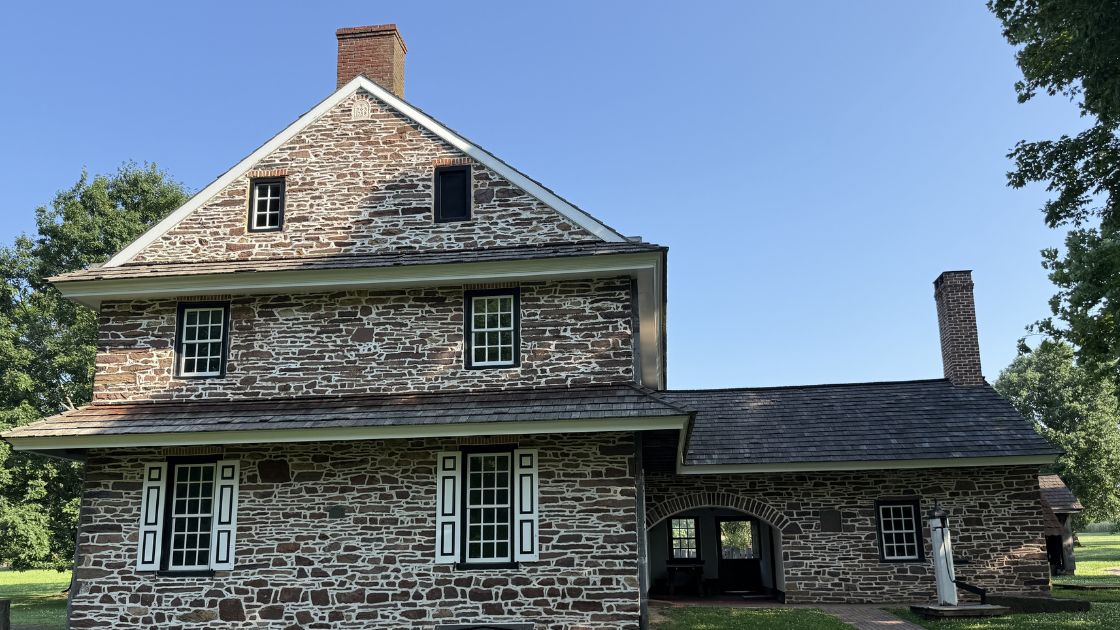
Peter Wentz Farmstead

The Peter Wentz Farmstead is a restored historic building located on 2030 Shearer Rd in Lansdale. According to Montgomery County, the land was first settled by German immigrants Peter and Rosanna Wentz in 1744. During 1777, George Washington established a temporary headquarters on the farm, says the county. The farmstead is open for tours from 10 a.m. to 3 p.m. Tuesday through Saturday, and 1 p.m. to 3 p.m. Sundays.
Camp Woods Preserve

After the unsuccessful Battle of Germantown, Washington and the Continental Army stopped in what is now Camp Woods Preserve near Lewis Lane. The land was originally named Dawesfield, and a historic mansion built in 1736 stands there to this day. According to the Wissahickon Trails, the Continental Army camped on the land for 16 days. Today, Camp Woods serves as a public park with trail systems running through forests and meadows.
Boehm’s Church

While recovering from their defeat, the Continental Army used Boehm’s Unitarian Church in Blue Bell as a temporary hospital, says the Wissahickon Valley Historical Society. Some soldiers died there and were buried in the church’s cemetery. Their graves are marked with an honorary tombstone and American flags.
The building is named for its founder, John Phillip Boehm, who founded the German Reformed Church (now part of the United Church of Christ) in PA. According to the WVHS, Boehm worked with Ben Franklin’s printing business as a German translator and established over 10 churches, with this one being his last. Boehm’s United Church of Christ continues to serve congregants today.
Blue Bell Inn

During his time at Camp Woods, Washington and his officers frequently stopped at the Blue Bell Inn, says the WVHS. The inn was built in 1743 and operated under the name the White Horse Inn during the Revolution. Taverns were hubs for Revolutionary War officers to trade information and form battle plans, as well as great places for spies to gather intelligence. The Blue Bell Inn is still open as a restaurant, now serving fine dining.
Fort Washington State Park

After staying in Whitpain, Washington marched his troops down Skippack Pike to what is now known as Fort Washington State Park. The British occupied Philadelphia at the time and marched from the city to battle the Americans. According to Pennsylvania’s Department of Conservation and Natural Resources, only a few local skirmishes occurred. After the British returned to Philadelphia, Washington took his army to Valley Forge where they would spend a harsh winter.
Fort Washington is now open as a public park.
For more information about the region’s history, readers can visit Pennsylvania Historical and Museum Commission | Commonwealth of Pennsylvania
Photos – Suzanne McNaughton